


Doraemon is a beloved series that has shaped the childhood of many. At first glance, it seems like simple, funny stories about a clumsy boy named Nobita and a robotic cat from the future. But as you grow older and revisit it, you realize Doraemon is much deeper. Beneath the strange gadgets and humorous situations lie valuable lessons about family, parenting, and how a child’s character is formed. If there’s one family in Doraemon that sparks the most curiosity, it’s definitely Shizuka’s family.
While Doraemon’s own background remains mysterious, Nobita grows up in an average household, Jaian’s family struggles financially, and Suneo’s is portrayed as wealthy, Shizuka’s home stands out as calm, neat, modest, and polite. There’s no showiness, no loud drama. This quiet atmosphere makes many wonder who Shizuka’s parents are, what they do for a living, and how they’ve raised such a nearly “perfect” daughter for over half a century without ever feeling off-putting.
From the very first episodes, Shizuka is portrayed as the ideal student. She’s smart, well-behaved, soft-spoken, and caring. She plays the violin, loves reading, enjoys daily baths, and keeps her surroundings tidy. These small details create an image of a refined young lady raised in a well-ordered household. It’s not about flaunting wealth but about growing up in a stable environment with clear values.

The creator Fujiko F. Fujio never explicitly states Shizuka’s parents’ professions in the main story, but throughout Doraemon there are enough clues to piece together their family portrait. Shizuka’s father, Yoshio Minamoto, often appears in a tidy suit, carrying a briefcase, reading the newspaper in the morning, and coming home on time in the evening. This strongly suggests he is an educated office worker with a stable income and disciplined lifestyle. He’s not a tycoon nor someone constantly away for work, but a calm, responsible family pillar.
Shizuka’s mother, Michiko Minamoto, is a full-time homemaker. She’s usually seen in the kitchen, cleaning the house, speaking softly to her daughter, rarely raising her voice. In some special episodes, Doraemon reveals she was once a renowned violinist in her youth. This explains why Shizuka was exposed to music early and developed artistic talents. But more important than her glamorous past is her choice to step back, care for the family, and create a warm, stable home environment.
Shizuka’s family apartment is always bright, clean, with a piano, a spacious bathtub, and a balcony full of flowers. These details indicate they belong to a stable middle-class, even slightly above average for Japanese society at the time. They’re not wealthy in a flashy way like Suneo’s family, nor struggling like Nobita’s or Jaian’s. This “just right” balance forms the crucial foundation for a child’s healthy psychological development.
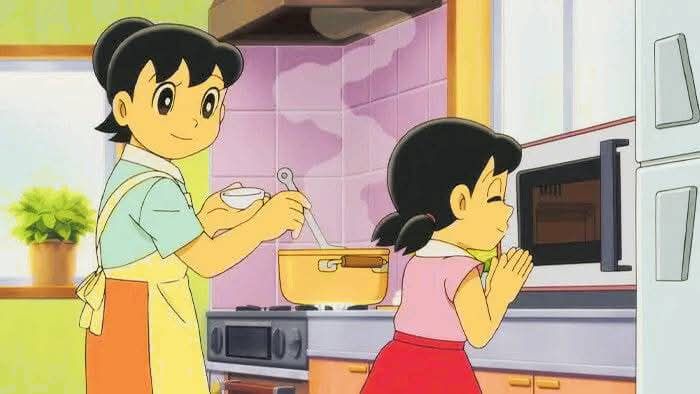
Shizuka is neither arrogant nor insecure. She knows her worth but doesn’t use it to overpower others. She sympathizes with Nobita but is wise enough not to be taken advantage of. This balance isn’t innate. It’s the result of a family environment where children are respected, heard, and shown good examples daily. From her father’s polite behavior toward her mother to her mother’s gentle reminders, these are quiet but effective lessons in emotional intelligence.
One small but meaningful detail is that throughout the series, Shizuka’s parents rarely scold her harshly. Not because she’s perfect, but because she was raised in a family that values dialogue over punishment. This parenting style still feels right even 50 years later. No yelling, no corporal punishment, no boasting about achievements. Just a stable, respectful, and loving environment.
In today’s world, many parents chase money, elite schools, awards, and medals, often forgetting that home is a child’s first classroom. How parents talk to each other, respond to mistakes, stay calm or vent anger, all these leave deeper marks on a child than any lesson.
Shizuka’s family isn’t perfect in terms of wealth or power. But their orderliness, peace, and subtlety have shaped a girl who remains an ideal role model for over half a century. Looking closely at Shizuka’s home reveals a parenting philosophy that is skillful, enduring, and profound enough to accompany a child throughout life.