


This summer, the global film scene is set for an extraordinary meeting between two giants separated by nearly three millennia: the blind poet Homer and director Christopher Nolan. With his blockbuster project The Odyssey, Nolan brings the foundational masterpiece of Western literature to the big screen. The fusion of the greatest epic in history and a visionary director known for aesthetic precision, realism, and playing with time promises a breathtaking and explosive cinematic experience in IMAX theaters.
However, watching a Christopher Nolan film is never a casual stroll, especially with a 173-minute epic like The Odyssey. Homer’s Greek mythological world is not just about battles against monsters or divine intervention, it’s a labyrinth of metaphors about human nature, psychology, and the scars of war. Understanding the original context doesn’t spoil surprises, instead, it’s the key to fully appreciating the layers of meaning and artistic intent Nolan weaves into the film.
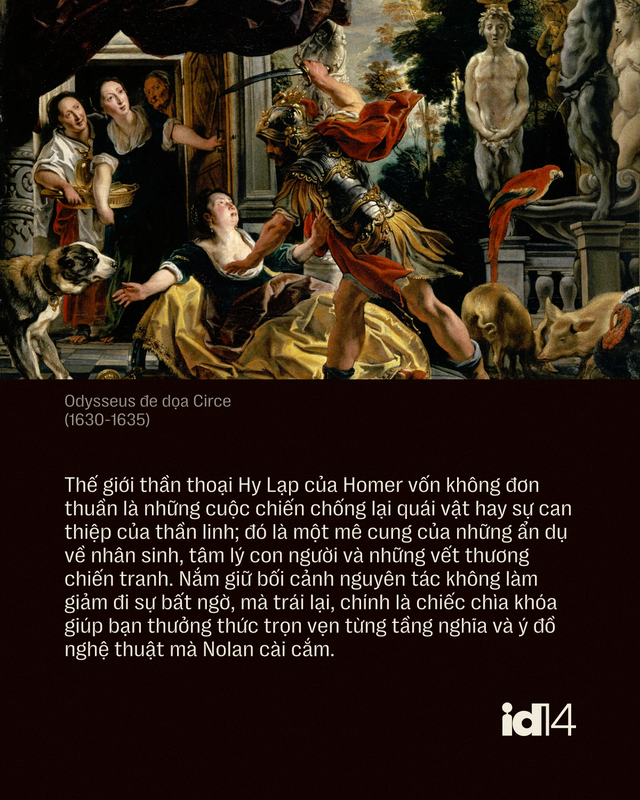
This article serves as a “map” to help you organize key myths, decode characters, and grasp the spirit of the original before Odysseus’s ship sets sail.
Who is Homer and why is The Odyssey the “sequel” in a mythological universe?
To understand the scale of the world Nolan recreates, we must first travel back to the 8th century BC, where the legendary figure Homer laid the cornerstone of human literature.
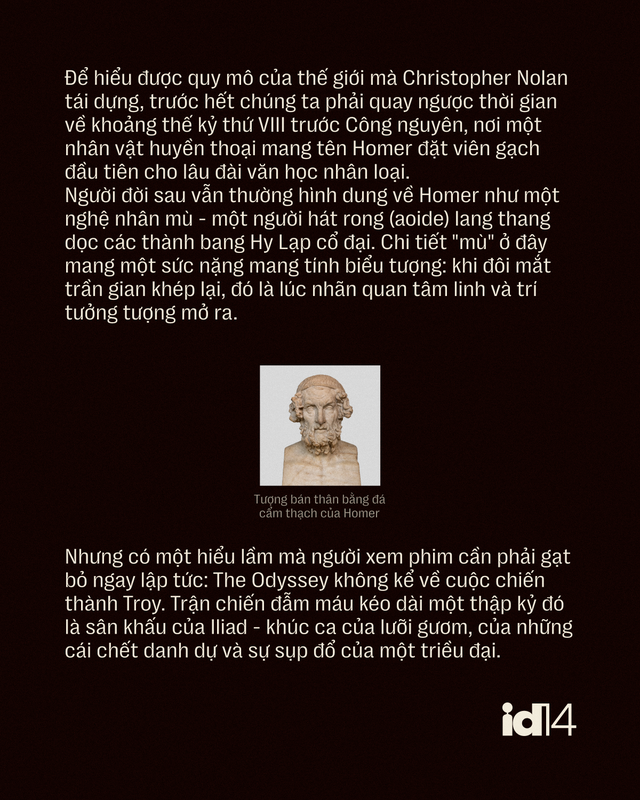
Later generations often picture Homer as a blind bard, a wandering singer (aoide) traveling between ancient Greek city-states. His blindness carries symbolic weight: when physical sight closes, spiritual vision and imagination open. In the ancient world, Homer’s epics were vibrant melodies, sung with lyres and passed down orally from generation to generation around campfires.
“The Iliad is the song of the dry bones on the battlefield, The Odyssey is the echo of survivors seeking their way home.”
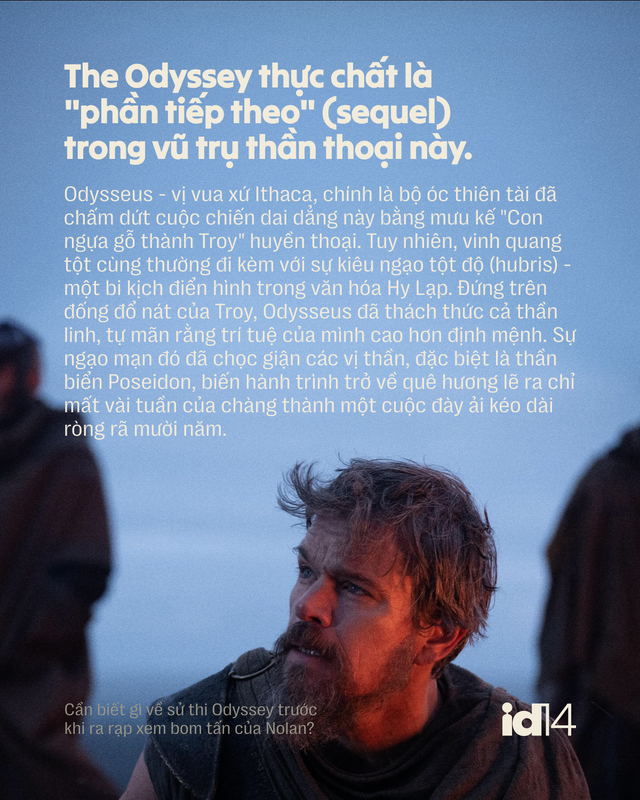
But there’s a crucial misconception viewers must discard immediately: The Odyssey does not recount the Trojan War. Instead, it is the “sequel” in this mythological universe. The story begins right after the war’s end, when the smoke of Troy has cleared and the surviving soldiers rise from the ruins. Odysseus, king of Ithaca, was the brilliant mind behind the legendary Trojan Horse that ended the long war. Yet, ultimate glory often breeds extreme pride (hubris), a classic Greek tragedy. Standing amid Troy’s ruins, Odysseus defied the gods, arrogantly believing his intelligence surpassed fate. This hubris angered the gods, especially Poseidon, god of the sea, turning what should have been a weeks-long journey home into a decade-long ordeal.
Odysseus’s ten years of exile at sea were more than a journey, they were a brutal stripping away. Poseidon’s ocean swallowed his comrades and ships one by one, robbing the Ithacan king of all royal glory. He faced challenges beyond mortal limits: seven years imprisoned on the lonely island of the goddess Calypso, encounters with the witch Circe who turned men into beasts, and binding himself to the mast to resist the deadly song of the Sirens. To survive, Odysseus even descended to the underworld to seek guidance. Each stop on his voyage stripped away his pride, turning the Trojan hero into a lone, destitute soul adrift on the vast ocean.
Meanwhile, back on Ithaca, a silent but fierce tragedy unfolds. With no news of their king for twenty years, Ithaca’s kingdom falls into chaos. Over a hundred cunning and greedy nobles invade Odysseus’s palace, slaughtering livestock, draining wine stores, squandering royal wealth, and pressuring Queen Penelope to remarry.
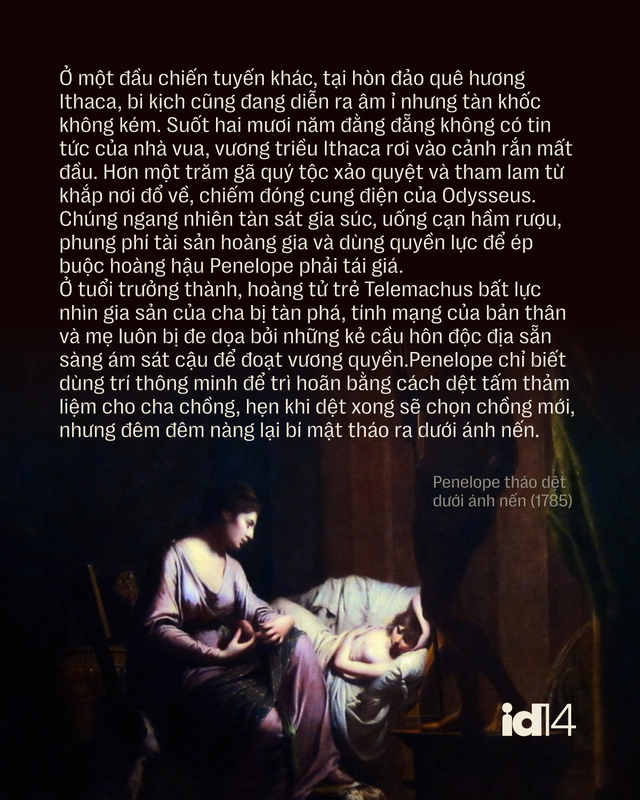
Now grown, Prince Telemachus helplessly watches his father’s estate destroyed, while his and his mother’s lives are threatened by ruthless suitors willing to kill him to seize the throne. Penelope uses her wit to delay, weaving a burial shroud for her father-in-law and promising to choose a new husband once it’s finished, secretly unraveling it each night by candlelight. Ithaca is no longer a peaceful harbor awaiting its hero but a “tiger’s den” filled with political traps. If Odysseus returns, he faces a deadly battle on his own soil to reclaim his family and kingdom.
If The Iliad is a heroic ode to glorious death on the battlefield, The Odyssey is a survival story filled with reflection. For ancient Greek soldiers, surviving and returning home (nostos, the root of “nostalgia”) was a battle even harsher than fighting enemies. Viewers should remember this: they are not witnessing a conquest of new lands but accompanying a broken soul fighting fate to find home again.
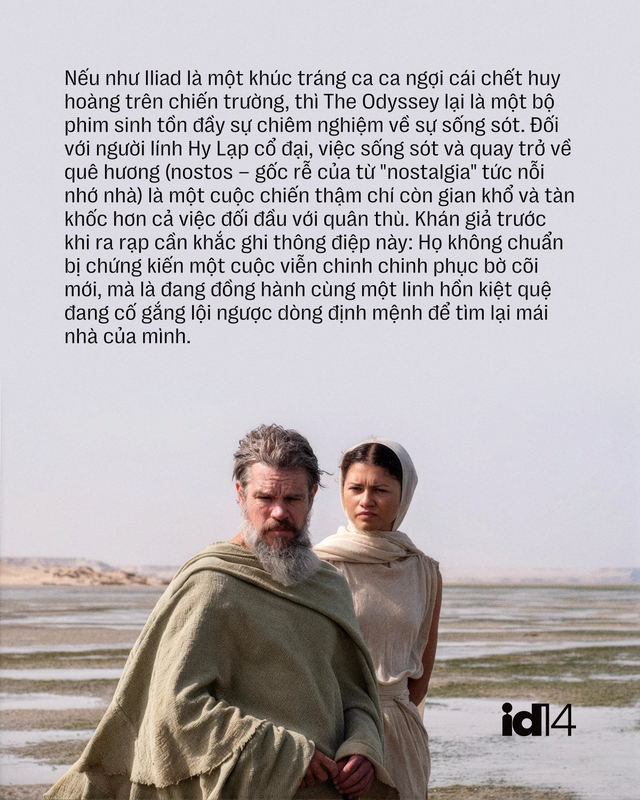
Decoding The Odyssey: The Strength of a Mortal
If The Iliad celebrates the destructive power of muscle and heroic deaths, The Odyssey opens a different chapter of ancient epic: the survival journey of a lone mortal against the fury of fate. In modern English, “odyssey” has shed its proper noun origins to symbolize arduous journeys where humans are pushed to their limits. This expedition is not defined by monster-slaying feats like Hercules or Achilles’ terrifying sword swings. Instead, it’s a harsh test of spirit, where the hero’s ultimate weapon is not a blazing sword but Metis, practical intelligence, cunning, and sharp adaptability.
“The Odyssey is not a journey to conquer the world, but a great retreat to find oneself amid the ruins of war.”
To survive ten years adrift, Odysseus abandons the proud warrior image to become a ruthless pragmatist. He lies, disguises himself, and even erases his identity by calling himself “Nobody” (Outis) before the one-eyed giant Polyphemus. The greatness of this journey lies in demystifying the perfect hero. It reveals a harsh truth: on the vast ocean of fate, the last survivor is not the strongest but the one who bends with the wind, willing to become a ragged beggar while waiting for the right moment.
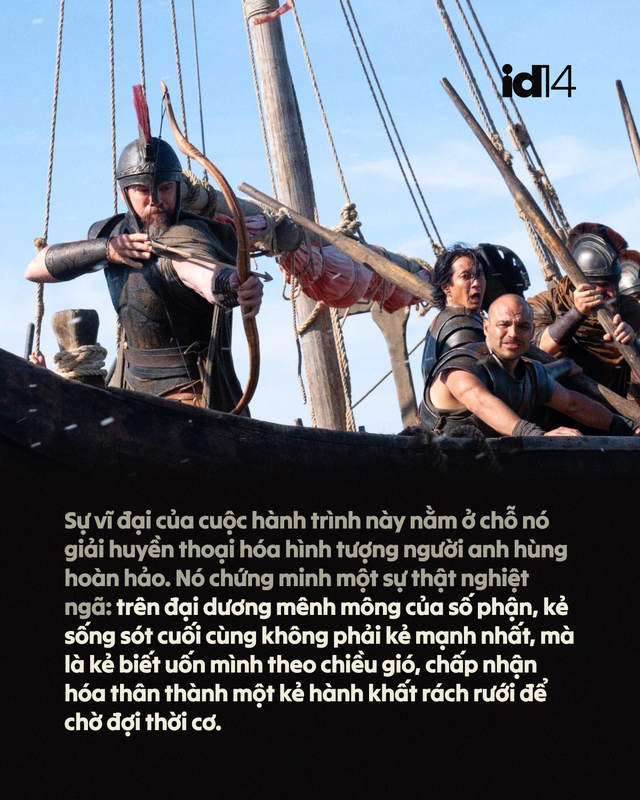
Beyond geography and supernatural forces, the greatest tragedy of this odyssey lies in its psychological depth. It is a journey through deep emotional scars, what modern medicine calls post-traumatic stress disorder (PTSD). Ten years of brutal war at Troy eroded Odysseus’s humanity, and the following decade of drifting is his struggle to hold on to his “human” side amid temptations of oblivion and traps of desire.
The conflict between the cold survival instincts of a general and the yearning to return as a husband and father shapes the epic’s emotional core. This gritty psychological material is fertile ground for Christopher Nolan. Through his lens, Odysseus’s return won’t be a rosy adventure but a painful, realistic psychological dissection of a broken soul fighting to reclaim a lost self.
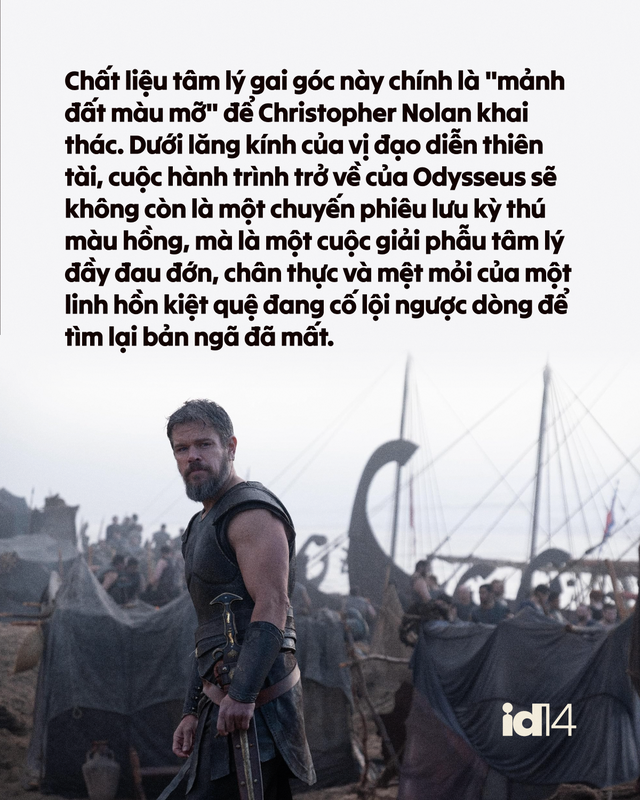
“The Underworld Map” and the Supernatural Forces You’ll Encounter
To set up this arduous journey, The Odyssey places humans in the middle of a cosmic chessboard ruled by supreme gods and terrifying supernatural beings. When you enter the theater, you need to identify the two opposing forces that directly influence the hero’s fate.
First is Poseidon, god of the sea, the greatest enemy and nightmare of the journey. His wrath ignites after Odysseus blinds his one-eyed giant son, Polyphemus. On a deeper level, Poseidon embodies the boundless, chaotic, and merciless fury of nature. Each storm he unleashes douses hope and reminds humans of their helplessness against the vast universe.
Opposing Poseidon is Athena, goddess and protector of Odysseus and his son Telemachus. Athena represents wisdom, reason, and justice. Her quiet but persistent support symbolizes that although humans are small before natural disasters, they can overcome them through reason and clarity.
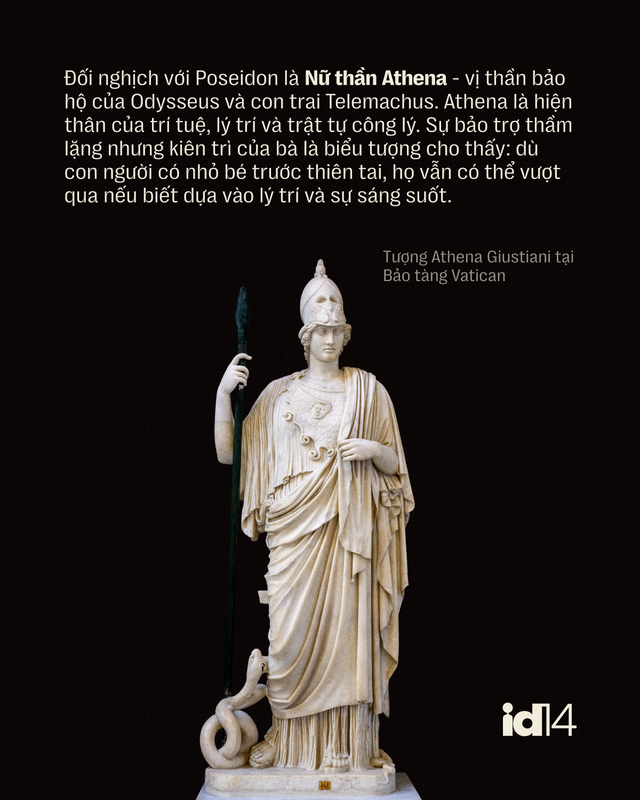
“The world of The Odyssey traps humans between two pincers: the blind fury of nature (Poseidon) and the guiding light of reason (Athena).”
On his drifting voyage through uncharted waters, Odysseus faces three highly symbolic trials that Nolan will surely bring to vivid life on the big screen.
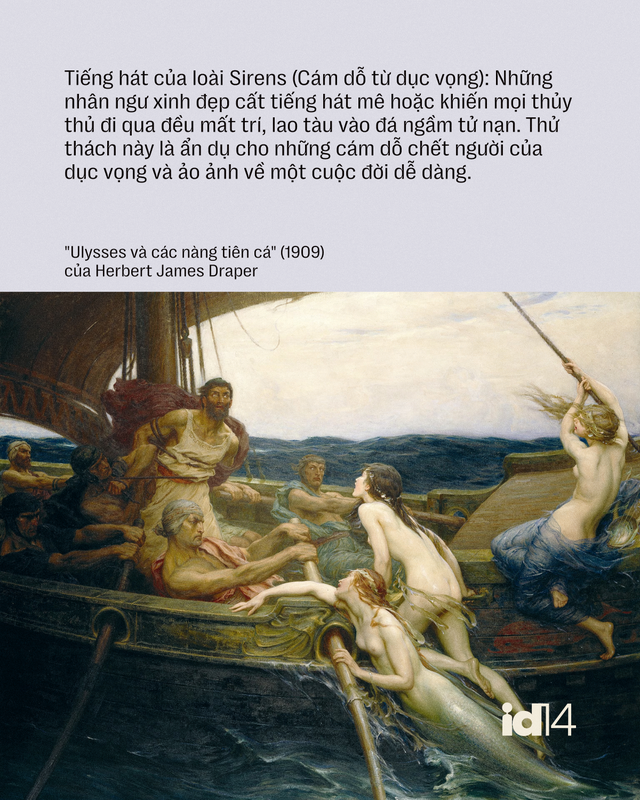
First is the Sirens’ song (Temptation of desire). These beautiful mermaids sing enchanting songs that drive sailors mad, causing ships to crash on rocks. This trial symbolizes deadly temptations of desire and illusions of an easy life. To survive, Odysseus orders his crew to plug their ears with wax while he binds himself to the mast, able to hear but unable to yield.
Next are Scylla and Charybdis (A deadly dilemma): a deadly strait with the six-headed monster Scylla snatching sailors from the deck on one side, and the giant whirlpool Charybdis swallowing everything on the other. This classic symbol represents a leader’s harsh choice: sacrifice some men (via Scylla) to save the ship, rather than risk losing all (via Charybdis).
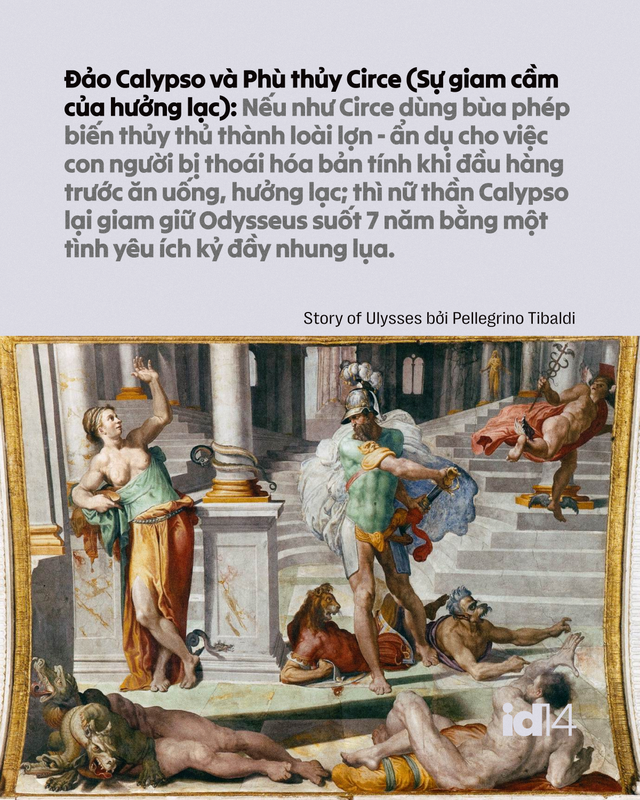
Third are the island of Calypso and the witch Circe (Captivity of indulgence): Circe’s magic turns sailors into pigs, an allegory for humans degenerating when surrendering to gluttony and pleasure. Calypso imprisons Odysseus for seven years with selfish, luxurious love. Both are sweet traps that quietly erode fighting spirit and make one forget the way home.
Recognizing this “map” before watching will help you understand why every step Odysseus takes is so lonely and painful. The real challenge isn’t slaying monsters but keeping the flame of longing for home alive against these supernatural forces.
Why Nolan Is the Perfect Director for This Epic
There is a strange connection spanning millennia between Homer’s narrative style and Christopher Nolan’s cinematic vision. This link convinces many that no one but the director of Inception and Oppenheimer could bring The Odyssey to the screen so fully.
The clearest connection is the nonlinear narrative structure. Many mistakenly believe that reverse storytelling and layered timelines are modern film inventions. In reality, as early as the 8th century BC, Homer used the In medias res technique (starting in the middle of the story) in The Odyssey. Instead of a linear timeline, the epic begins with Odysseus imprisoned on Calypso’s island for years, then uses fragmented memories and flashbacks to recount the prior decade of wandering. This “looping” structure and time gaps are Nolan’s signature playground. Audiences can expect a fast-paced editing style where past, present, and the hero’s psychological illusions intertwine, creating a challenging and intellectually stimulating cinematic maze.

Ten years of war washed in blood, ten years of drifting tested by the ocean, all prove that home is not just a place on a map but the only place a broken soul can find forgiveness and peace.
“The greatest expedition is not conquering new lands but finding the way back to be an ordinary person.”