


The Odyssey and the Christopher Nolan Phenomenon
Few would have imagined that a nearly 3,000-year-old Greek epic could become a global box office sensation in 2026.
Yet that is exactly what The Odyssey has achieved.
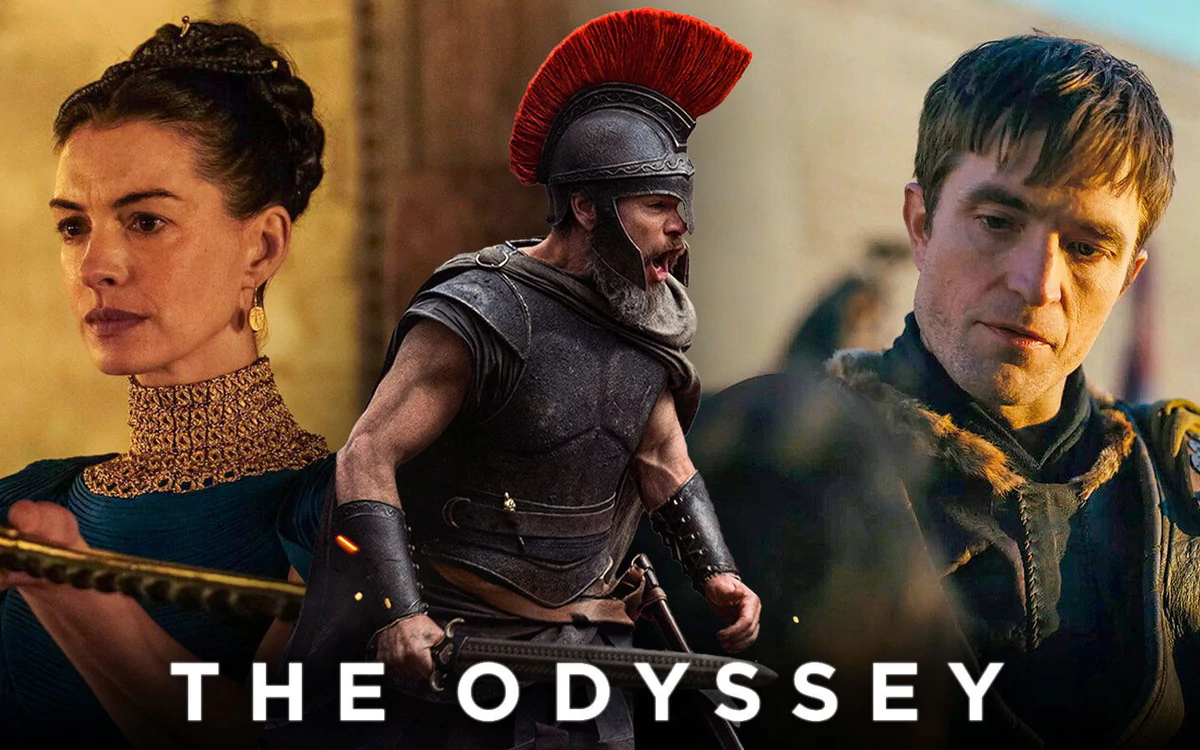
With $264.1 million in global revenue after its opening weekend, this figure is more than just impressive. It confirms that even in the era of TikTok, YouTube Shorts, and streaming, millions of viewers are still willing to pay to watch a story many once studied in school.
This success becomes even more remarkable when considering the film’s source material.
The Odyssey is not based on a popular superhero franchise. It’s not a sequel to a blockbuster series. Nor is it adapted from a video game or comic book with a massive fanbase. Christopher Nolan chose to adapt Homer’s epic Odyssey, one of Western civilization’s oldest works.
Box office data shows nearly half of the opening week’s audience was aged 18 to 34. On Letterboxd, The Odyssey became the fastest film ever to reach one million “watched” marks. IMAX tickets sold out months in advance.
Even screenings at 2 or 3 a.m. were fully booked. This is a rare phenomenon in an age when most blockbusters appear on streaming platforms just weeks after release.
Christopher Nolan Has Become a Brand
For years, star power has been key to drawing audiences to theaters. However, Christopher Nolan is among the few directors whose name alone motivates ticket sales.
Audiences don’t buy tickets for The Odyssey just because of Matt Damon, Tom Holland, or Zendaya. They buy tickets because it says “A Film by Christopher Nolan.” That kind of influence is rare in cinema history.

From Memento, The Prestige, Inception, and Interstellar to Oppenheimer, Nolan has rarely repeated himself. Each film differs in setting, genre, and storytelling style, yet carries a distinct signature recognizable within minutes.
This creates a unique bond between Nolan and his audience. They don’t just watch a movie, they watch how Christopher Nolan chooses to tell the story.
Perhaps that’s why The Odyssey quickly transcended the typical blockbuster to become a cultural event.
On social media, fans discuss camera angles, aspect ratios, sound design, battle scene staging, and Odysseus’s journey as much as the plot itself.
Many plan to watch it a second or even third time to catch details missed on their first viewing.
This is the kind of effect Hollywood saw with Interstellar and Oppenheimer.
Now, it’s happening again with The Odyssey.
The Odyssey’s Success Is Not Just About Christopher Nolan
Focusing only on the British director’s reputation overlooks another key player.
That player is IMAX.
The Odyssey is the first feature film ever shot entirely with the new generation IMAX Film cameras. This means IMAX is no longer just a projection format but the foundation upon which the entire film was created.
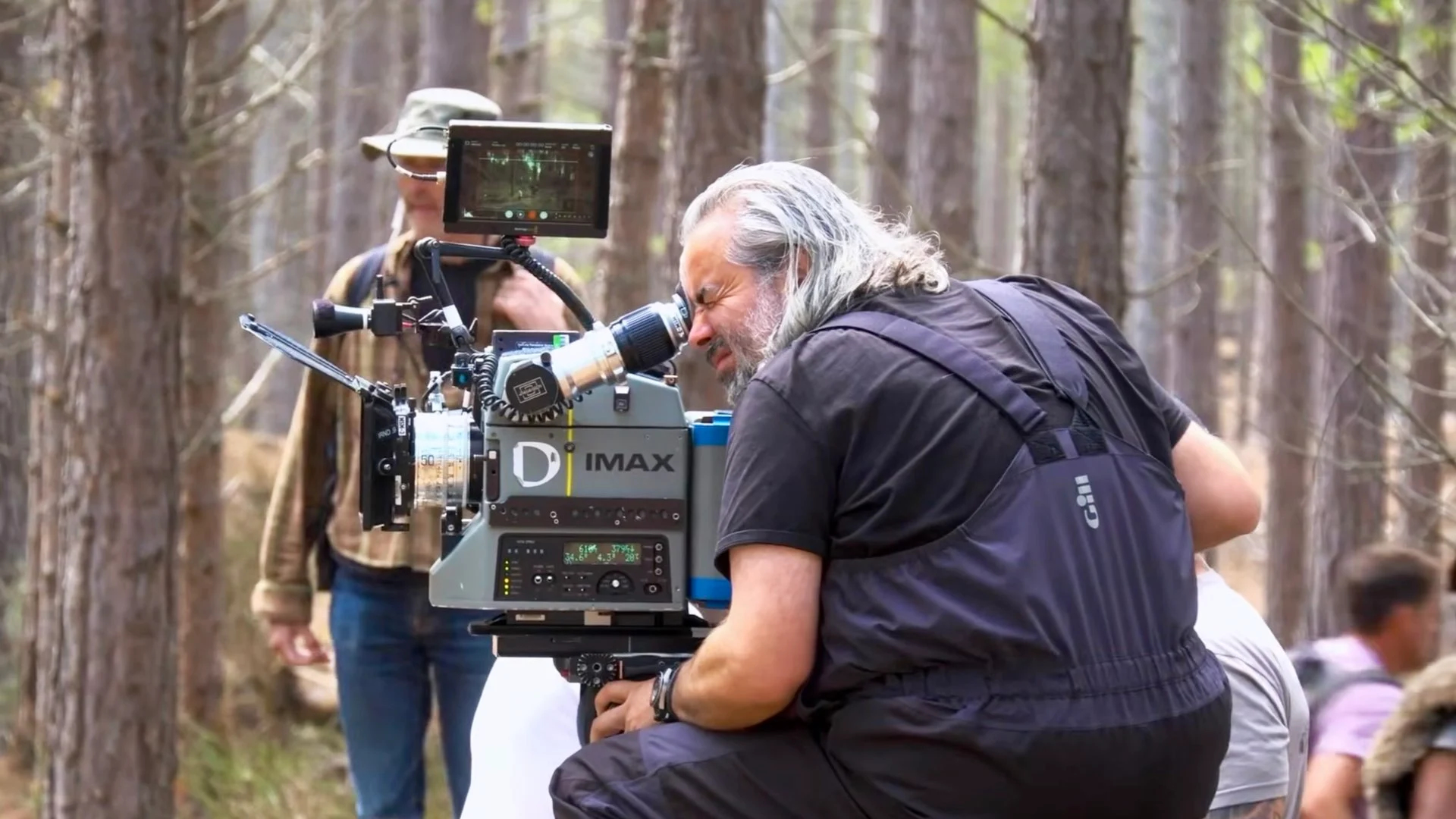
In numerous post-release interviews, Richard Gelfond, CEO of IMAX, emphasized that The Odyssey was made to be seen on IMAX screens, not just a film with an IMAX version.
The box office numbers reflect this.
IMAX screenings alone brought in over $51 million during the first week, nearly a quarter of the film’s global revenue. This is a rare ratio for a Hollywood blockbuster and shows many viewers deliberately chose IMAX over standard theaters.
Some theaters dedicated three full weeks exclusively to showing The Odyssey in IMAX.
Meanwhile, IMAX 70 mm screenings, a format Nolan has championed, were nearly sold out from the start.
This raises an interesting question.
What makes millions willing to pay higher ticket prices, wait longer in lines, and travel hundreds of kilometers just to watch the same film on a different screen?
Is IMAX really that different?
Or has Christopher Nolan transformed a projection technology into an essential part of the cinematic experience?
Decoding IMAX: The Technology Nolan Has Pursued for Nearly Two Decades
If The Odyssey is the pinnacle of Nolan’s career, then IMAX is the path that led him there.
Few know Nolan’s relationship with IMAX began in 2008 with The Dark Knight. At that time, most Hollywood directors saw IMAX as a “spice” reserved for explosive or chase scenes. IMAX cameras were huge, heavy, noisy, and could only film for a few minutes before needing a film reel change.
Even IMAX itself didn’t expect its technology to be used for a full-length narrative film.
But Nolan saw something different. He wasn’t attracted by the giant screen. He was fascinated by the amount of image the camera could capture.
While many directors used IMAX for spectacle, Nolan treated IMAX as a storytelling language. This difference has defined his work for nearly twenty years.
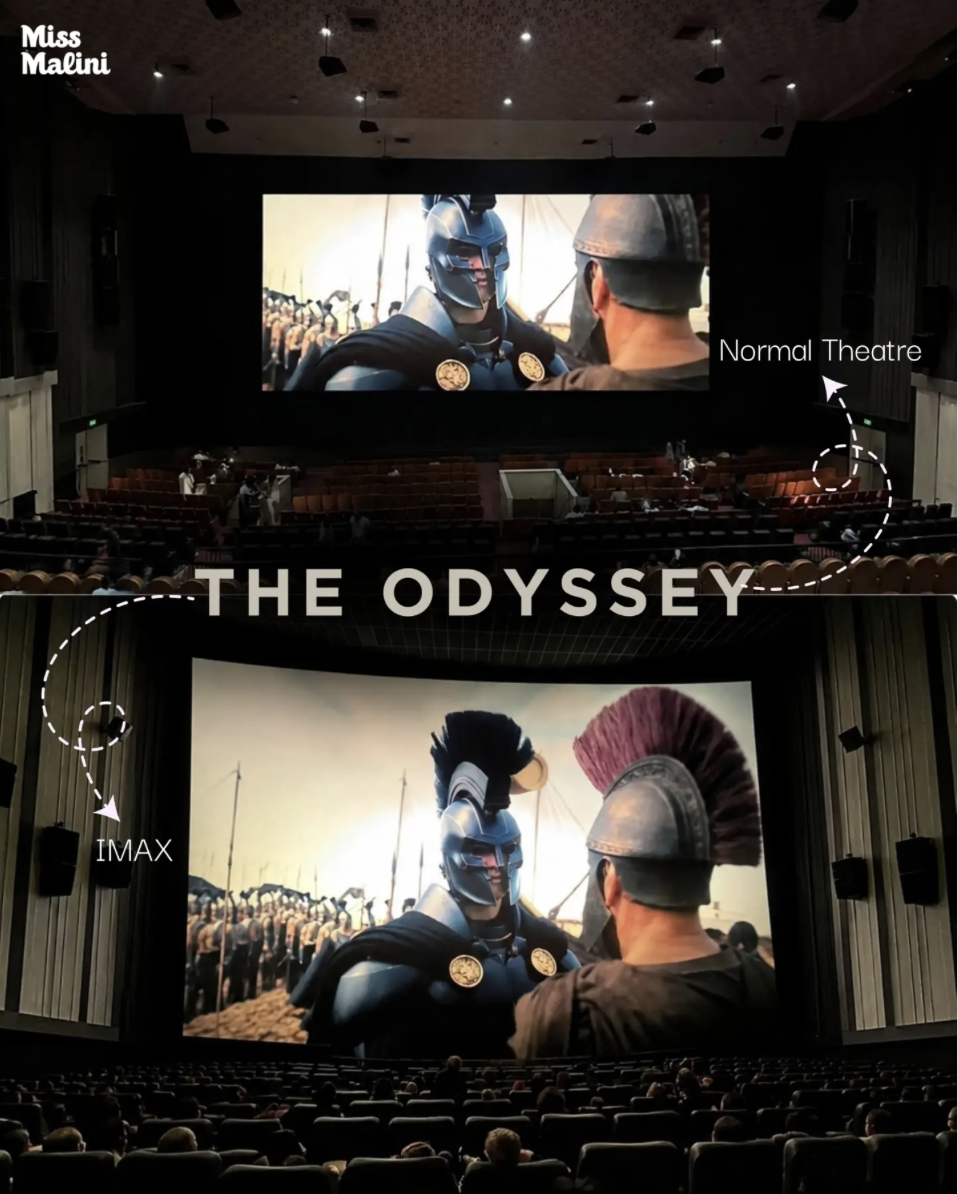
This is the most important distinction. For years, many viewers thought IMAX was simply a bigger screen with better sound.
That’s true, but it’s not the whole story. IMAX’s difference starts with the camera.
What sets IMAX apart isn’t the giant screen or the sound system, but the camera itself. Most viewers never notice this.
IMAX cameras use 65 mm film or sensors much larger than standard cinema formats. A larger image area means each frame captures more light, more detail, and a wider contrast range.
Simply put, if a regular cinema camera is like looking through a window, IMAX is like opening the door wide. The scene becomes broader, deeper, and richer in detail.
That’s why Nolan’s films make viewers feel like they’re not just watching but standing inside the movie’s world.
In Interstellar, audiences don’t just see distant planets, they feel like they’re floating in endless space.
In Dunkirk, the sky and sea nearly engulf the entire screen.
In The Odyssey, the Mediterranean Sea, cliffs, and naval battles are recreated on a scale that regular screens struggle to fully convey.
Christopher Nolan Films from the IMAX Perspective
This is what truly sets Nolan apart.
Most Hollywood films are “converted to IMAX” after shooting. The Odyssey was written, directed, and shot for IMAX from day one.
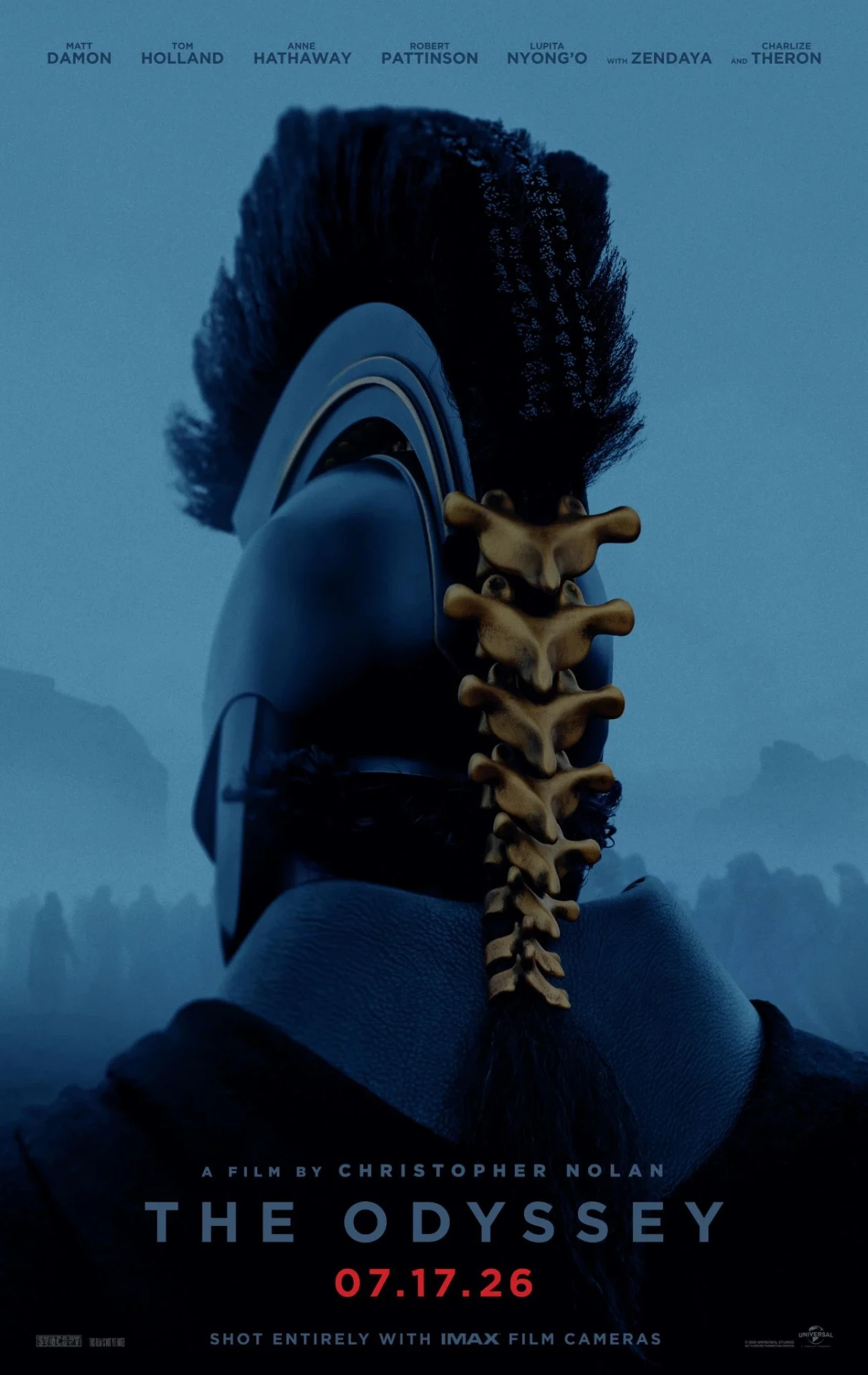
For Nolan, everything happens the other way around. He builds the visual language around IMAX’s capabilities starting with the script.
Every shot, composition, and the distance between characters and the sky, sea, or architecture is carefully planned to maximize IMAX’s tall frame.
That’s also why he opposes cropping the frame to fit smaller screens.
According to Nolan, cutting the top and bottom of the frame doesn’t just remove a few centimeters of image.
It removes part of the storytelling intent.
This explains why The Odyssey is promoted as the first film shot entirely with the new generation IMAX camera system.
This is not a marketing gimmick.
It’s Nolan’s way of affirming that IMAX is no longer a supporting tool but the foundation on which the film was created.
Not All IMAX Theaters Are the Same
Interestingly, even after buying an IMAX ticket, the viewing experience can vary greatly. This is why cinephiles are willing to drive hundreds of kilometers to a specific theater.
Buying an IMAX ticket doesn’t guarantee you’re seeing the version Nolan intended. Only a few theaters worldwide can show the full IMAX GT 1.43:1 aspect ratio.
This is because IMAX exists today in multiple standards.
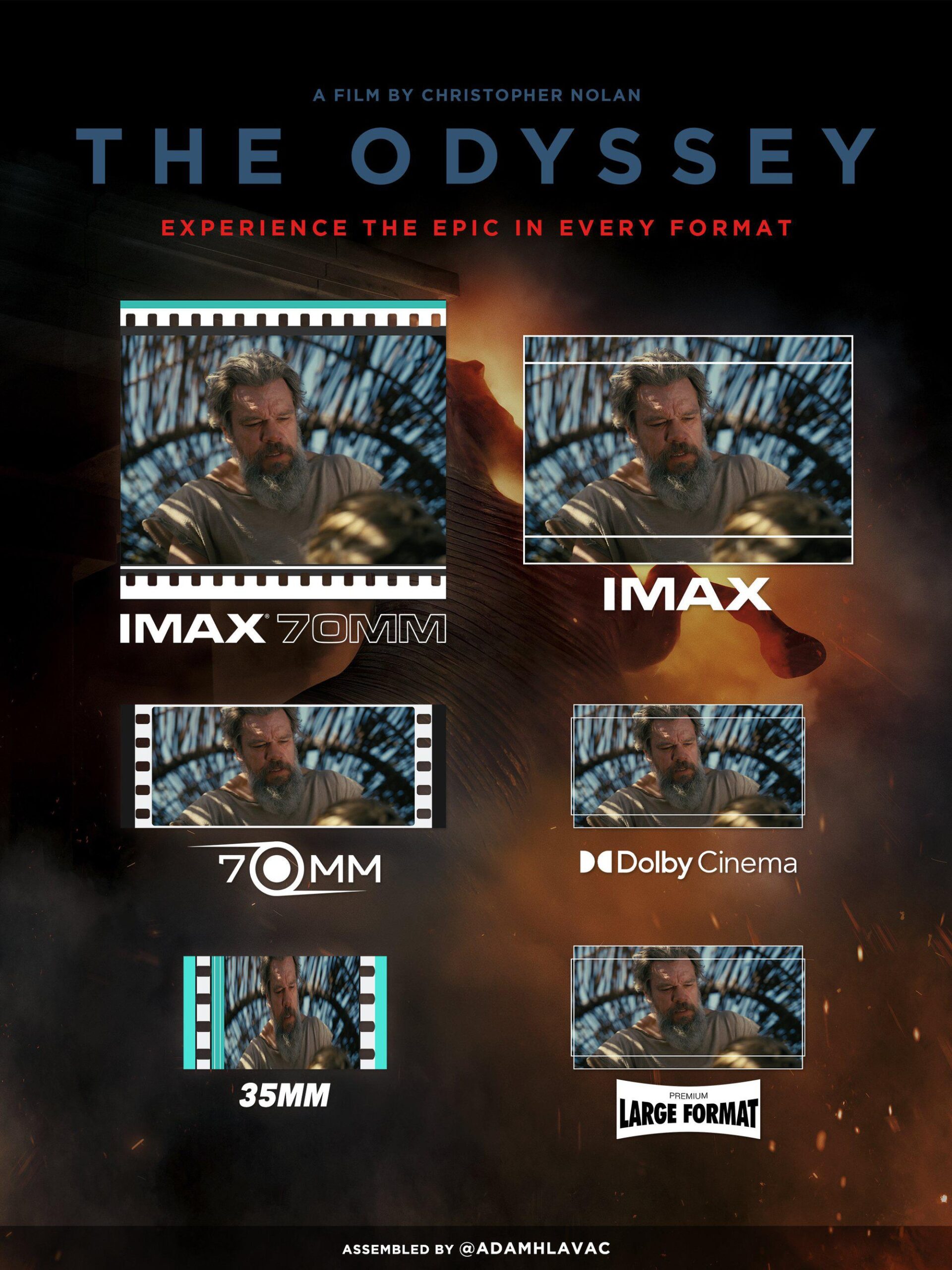
The most common is IMAX Digital with a 1.90:1 aspect ratio. This format is found in most theaters worldwide and still offers sharper images and superior sound compared to standard cinemas.
However, the experience Nolan always refers to is IMAX GT with a 1.43:1 screen ratio.
These theaters have significantly taller screens and use dual laser projectors or 70 mm film projectors. When a film is shot with IMAX cameras, this format can display nearly the entire frame the director captured.
What makes IMAX GT special isn’t just the bigger screen but that audiences see more of the image. The 1.43:1 ratio preserves almost the entire frame recorded by the IMAX camera.
This difference may seem minor on paper but creates a completely different feeling in the theater.
In a panoramic shot, viewers don’t just see the character in front.
They also sense the vast space above, the depth of the sky, and the scale of the ship sailing the sea.
This is what Nolan often calls an “immersive experience,” one that truly draws audiences into the film’s world.
The Odyssey Is Not the Beginning. It’s the Result of Nearly 20 Years Chasing an Idea
Looking back at Christopher Nolan’s career, each film marks a step forward in expanding IMAX’s limits.
With The Dark Knight, he proved IMAX could be used for storytelling.
Interstellar transformed space into an overwhelming experience.
Dunkirk made war feel more real than ever.
Oppenheimer pushed IMAX to develop the first-ever 65 mm black-and-white camera to realize his vision.
Few directors have the power to make a tech company develop new hardware just to serve their vision. Christopher Nolan is one of them.
By the time of The Odyssey, Nolan no longer had to convince IMAX. Instead, IMAX developed technology to keep pace with his ambitions. This is perhaps the most significant milestone. Nolan is not just a director using IMAX.
He helped redefine the technology, turning it from a projection format into a cinematic language.
The Odyssey’s greatest legacy may not be its box office but how Christopher Nolan helped redefine IMAX as a storytelling language rather than just a projection technology.